
Challenging Speech Training in Neurological Patients by Interactive Gaming
Keywords:
Automatic speech recognition, Serious gaming, Speech therapy, Pronunciation feedback, Dysarhtria, Neurologic disordersSynopsis
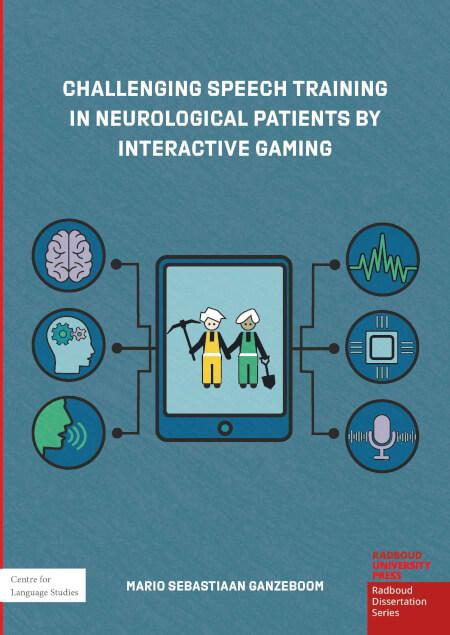
The majority of patients with neurological impairment like Parkinson's Disease (PD) or stroke are affected by dysarthria. Dysarthria is a motor speech impairment which leads to reduced speech intelligibility. Intensive and prolonged speech training can increase patients' speech intelligibility. Unfortunately, traditional interventions are generally provided only for a short time. eHealth applications may provide a solution. This thesis explored whether it is possible to develop a game that is suitable for providing speech training in elderly patients with dysarthria due to PD or stroke. Two versions of the game called Treasure Hunters, was developed. In both games two players cooperate and interact verbally to reach the goals of the game, while receiving automatic feedback on voice loudness, pitch, and pronunciation.
Participants played with the games in several sessions and generally appreciated it, hinting at their potential for speech training in elderly patients. In two within-subjects experiments the games were compared to a period of no training and to training with a non-game computer-based speech training system. The experiments showed that game-based speech training can have positive effects on speech intelligibility. Based on these outcomes, this thesis regards game-based speech training as a promising option in addition to existing types of speech training. What follows is that this thesis recommends to combine the strengths of all types of training to improve or stabilize speech intelligibility in patients with dysarthria.
Published
Series
Categories
License

This work is licensed under a Creative Commons Attribution-NonCommercial-NoDerivatives 4.0 International License.