
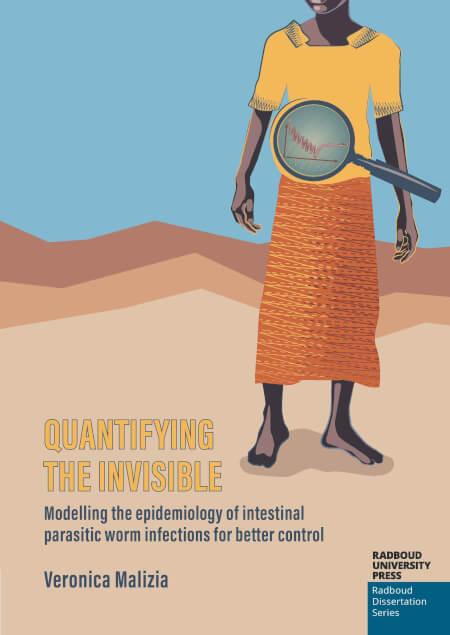
Quantifying the invisible: Modelling the epidemiology of intestinal parasitic worm infections for better control
Keywords:
Mathematical modelling, Intestinal parasitic infections, Soil-transmitted helminths, Schistosomiasis, Public health, Model calibrationSynopsis
Intestinal parasitic worm infections, including soil-transmitted helminths and Schistosoma mansoni, remain major public health challenges in many low- and middle-income countries. Mathematical and statistical models are increasingly used to support evidence-based control policies, yet important uncertainties remain regarding transmission dynamics, morbidity, diagnostics, and intervention strategies. This thesis advances the modelling of intestinal helminth infections to improve understanding of transmission and inform more effective control programmes. First, statistical models were developed to evaluate the appropriateness of the World Health Organization morbidity indicator for STH and to assess how diagnostic sampling schemes influence policy-relevant prevalence estimates. Second, stochastic agent-based models, including a newly developed framework, SchiSTOP, were used to evaluate the progress and effectiveness of interventions, and to investigate how alternative assumptions on transmission-regulating mechanisms influence S. mansoni dynamics and predictions. Finally, emulator-based calibration was applied to identify parameter uncertainty, assess model adequacy, and determine the epidemiological data most informative for calibration. Together, these modelling approaches demonstrate how quantitative methods can bridge knowledge gaps, improve interpretation of epidemiological data, and strengthen evidence-based decision-making for the control and eventual elimination of intestinal parasitic worm infections.
Published
Series
Categories
License

This work is licensed under a Creative Commons Attribution-NonCommercial-NoDerivatives 4.0 International License.