
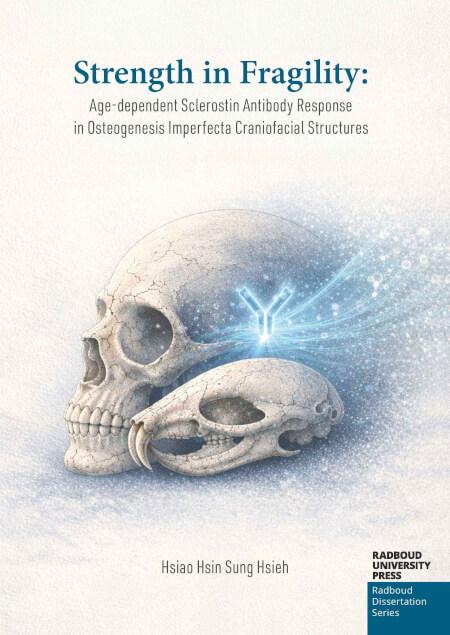
Strength in Fragility: Age-dependent Sclerostin Antibody Response in Osteogenesis Imperfecta Craniofacial Structures
Keywords:
Osteogenesis imperfecta, Craniofacial skeleton, sclersotin antibody, Bone regeneration, dental implants, Bone diseaseSynopsis
Osteogenesis imperfecta (OI) is a hereditary skeletal disorder characterized by impaired bone quality, recurrent fractures, and skeletal fragility. While research and clinical care have traditionally focused on long bones, craniofacial involvement can substantially affect facial growth, dental development, oral function, rehabilitation options, and quality of life. This thesis investigates craniofacial bone defects in OI and evaluates age-dependent responses to sclerostin antibody therapy as a potential regenerative strategy. Using epidemiological analyses, advanced imaging, biomechanical testing, molecular assessment, and genetically engineered mouse models, this work identifies the craniofacial skeleton as a clinically relevant site of OI pathology. Studies of alveolar bone remodeling highlight Wnt/β-catenin signaling as an important regulator of craniofacial bone adaptation and age-related bone loss, while population-level data reveal a disproportionate burden of fractures of the jaw, skull, and facial bones. Preclinical studies show that craniofacial abnormalities vary by mutation type, age, sex, and anatomical site. Sclerostin antibody treatment improves craniofacial bone mass, architecture, mechanical stability, and peri-implant bone quality in OI mouse models, although further studies are needed to establish long-term safety, optimal dosing, and clinical outcomes. Overall, this thesis supports individualized, precision-based craniofacial regeneration in OI.
Published
Series
Categories
License

This work is licensed under a Creative Commons Attribution-NonCommercial-NoDerivatives 4.0 International License.