
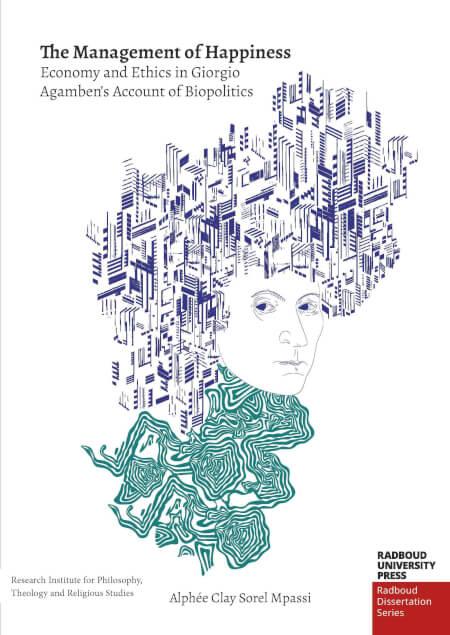
The Management of Happiness: Economy and Ethics in Giorgio Agamben's Account of Biopolitics
Keywords:
Biopolitics, continental philosophy, sovereignty, economy, happiness theory, governmentalitySynopsis
The book provides a systematic and critical analysis of the notion of ‘happiness’ or ‘the happy life’ in Agamben’s account of biopolitics. Its specificity lies in the fact that it examines the notion in question in close connection to the notion of ‘economy’ and ‘ethics’. Also, based on Agamben, I examined whether happiness should be conceived as an existential phenomenon that can or must be managed in preponderantly political and capitalistic terms or whether it is rather an ethico-ontological style of life proper to the individual in society.
Since the publication of the first volume of his Homo Sacer series, Homo Sacer: Sovereign Power and Bare Life, Agamben’s work has received a great deal of attention in secondary literature over the past years. Emphasis has been mostly put on his critical and at times negative perspectives on the current constitution and status quo of biopolitics. For this reason, he has been read as a negative thinker; one who has been very critical against biopolitics, but hardly offers any alternative. Contrary to that reading, I argue that there is an affirmative side in Agamben’s account of biopolitics. The waver of that affirmation is the notion of ‘form-of-life’ (the happy life).
The interpretation of form-of-life in Agamben has been carried out in close connection with the notions of ‘economy’ and ‘ethics’. One of the main objectives I pursued is to illuminate that the concept of ‘the happy life’ does not only bridge Agamben’s pars destruens and pars construens, but also constitutes the solution or the alternative he puts forward against the current aporia of biopolitics, as form-of-life, according to him, deactivates life from the capturing and managerial mechanisms of sovereign and economic biopolitics. Thus, happy life is not the type of life that fulfils some political and economic determinations. It is instead a becoming self and a being-at-home with the self, outside and beyond all political, legal, and economic restrictions.
Published
Series
License

This work is licensed under a Creative Commons Attribution-NonCommercial-NoDerivatives 4.0 International License.